
Driver Compliance Services

Ensuring Drivers are Compliant, Drug Free, & Reliable

our driver compliance services

At National Fleet Services, we are committed to ensuring the drivers you depend on are always compliant, drug-free and reliable. Let us handle your Driver Compliance, so you can focus on your business. Our Driver Compliance services include:

Computer screen with a check mark and document, indicating approval or completion.

driver compliance monitoring

Black and white award ribbon icon.

driver qualification

Black and white icon of a badge with a checkmark.

employment verification

Document with person icon, magnified by a magnifying glass with a question mark.

background screening

Gear icon with a person inside.

drug & Alcohol administration

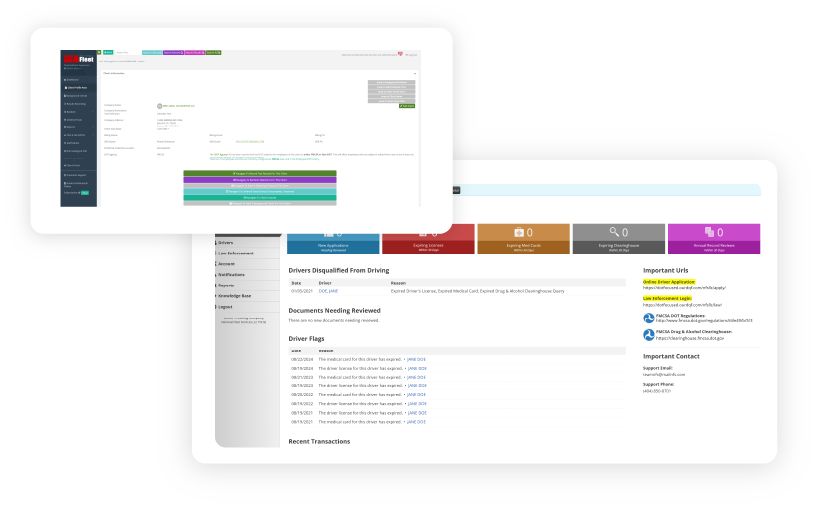
Two screens showing a dashboard with data visualization and a calendar interface.

DOTFocused software

National Fleet Services DOTFocus software specializes in providing online Department of Transportation (DOT) Driver Qualification (DQ) software, designed to streamline and automate the compliance process for commercial carriers and CDL drivers. ​

we helped keep these clients on the road

Any questions? We Have Answers

  • I want to open a new trucking company, what do I need?

    • Register your business and trademark the name
    • File for an EIN with IRS
    • Obtain a USDOT number & Authority
    • Obtain a BOC-3 Agent & Insurance
    • Obtain an IRP and IFTA account
  • How much does it cost to get your own trucking authority?

    The FMCSA charges $699 to file the paperwork and get your authority issued.

  • What is a BOC-3 processing agent?

    It’s an FMCSA agent or business that receives legal documents on behalf of a company. This includes court papers, complaints, and summons. Our related company 1+49 Process Agents LLC provides agents in all 50 states.

  • What is UCR?

    It’s an annual fee that all individuals or companies that operate commercial motor vehicles across state or international lines must pay based on the number of vehicles.

  • What is biennial?

    It’s an update with the FMCSA that requires entities to update their information every two years.

  • What is IFTA?

    It's a fuel tax collection and sharing agreement for the redistribution of fuel taxes paid by interstate commercial carriers.

  • What is HVUT?

    The heavy vehicle use tax or HVUT is a fee assessed annually on heavy vehicles operating on public highways at registered gross weights equal to or exceeding 55,000 pounds.

  • I bought a truck; how can I get it registered and get my plates?

    You will need to title the vehicle first with your local county and then add it to your IRP account.

  • I am running under somebody else’s authority; can I open an IRP account?

    Yes, as long as you have an Employment Agreement.

  • How does your drug & alcohol consortium work?

    We send drivers for a pre-employment test and once negative results are received, we will add the driver into our drug pool. Testing is conducted at a designated site across the US.

  • I’m the owner, but I don’t drive why do I have to be enrolled in a consortium?

    As an owner-operator of a commercial vehicle, even if you don't personally drive, you are still required to be enrolled in a consortium because DOT regulations prohibit single owner-operators from managing their own random drug and alcohol testing program.

  • I am enrolled in your consortium, but I have not been tested randomly, why?

    If you are enrolled in a drug testing consortium but haven't been randomly tested, it's likely because random selection is based on a large pool of drivers from different companies, meaning the odds of being chosen for a test at any given time are relatively low, especially if your company has a small number of drivers; essentially, your chances of being selected are diluted by the larger pool within the consortium. 

  • What is the Return to Duty process?

    It's a series of steps that an employee must complete to return to a safety-sensitive job after a drug or alcohol violation. The process includes evaluation, education, treatment, and testing. 

  • What is the FMCSA Portal? What do I need to open one?

    It’s an online platform that allows users, including carriers, brokers, and state officials, to access various safety data and information systems related to commercial vehicles with a single set of login credentials.  What do I need to open one? You will need to request your USDOT Pin and create a Login.gov account.

  • What is the Clearinghouse? What do I need to open one?

    It's a central repository to track CDL driver drug and alcohol test results and return-to-duty information.  What do I need to open one ? You need a valid email address and to create a login.gov account. You can use your existing login.gov account if you already have one. 

  • What is a Query?

    Detailed information about any violations found in a driver's Clearinghouse record. 

  • I drove zero miles this quarter, do I need to file an IFTA return?

    Yes, you must file a separate return each calendar quarter for each fuel type indicated on your initial or renewal application even when no miles were accrued that quarter.

fleet insights

Man holding a digital tablet managing fleet operations and freight logistics, standing near a lineup
January 30, 2026
Fleet management strategies for 2026: use telematics, real-time compliance tools, smart software, route planning, and training to cut costs.
By Matthew Bowles January 27, 2026
On January 8, 2026, the U.S. Department of Transportation (DOT) announced that the minimum random drug and alcohol testing rates for CDL drivers will remain unchanged. For calendar year 2026, the required testing rates are: 50% for random drug testing 10% for random alcohol testing This marks the sixth consecutive year that these rates have remained in effect following the Federal Motor Carrier Safety Administration’s (FMCSA) increase from 25% to 50% in January 2020. Based on current industry data, these testing levels are unlikely to decrease in the near future. Why the Testing Rate Remains at 50% FMCSA operates under a performance-based testing model established by its 2001 final rule, Controlled Substances and Alcohol Use and Testing. Under this rule: When the industry-wide positive random drug test rate reaches or exceeds 1.0% , FMCSA is required to maintain a 50% random testing rate . To reduce the rate back to 25% , the industry must demonstrate positive test rates below 1.0% for two consecutive calendar years . At present, the data does not support a reduction. The last decrease occurred in 2016 when positive test rates were low enough to justify a reduction to 25%. However, by 2018 the positive rate had climbed back to 1.0%, triggering the return to 50% testing beginning in 2020. What the Drug & Alcohol Clearinghouse Data Shows The FMCSA Drug & Alcohol Clearinghouse provides clear insight into why the testing rate has not changed. Since January 2020: Over 300,000 drug and alcohol violations have been reported 324,996 drivers have at least one violation on record More than 200,000 drivers are currently in prohibited status Over 150,000 prohibited drivers have not started the return-to-duty (RTD) process That last figure is particularly significant. More than 150,000 CDL holders remain sidelined and legally prohibited from operating a commercial motor vehicle, with no steps taken to regain eligibility. Substances Most Frequently Identified The Clearinghouse also tracks violations by substance. Since 2020, cumulative positive results show: Marijuana (Δ9-THCA): 171,270 Cocaine: 47,237 Methamphetamine: 24,589 Amphetamine: 22,932 Opioids (combined): 21,763 Other substances: 5,793 Marijuana alone accounts for approximately 60% of all positive drug tests . While marijuana may be legal at the state level in many areas, federal law strictly prohibits its use by CDL drivers . State legalization does not override DOT regulations. What This Means for Motor Carriers The Minimum Is a Floor, Not a Ceiling The 50% testing rate is the minimum requirement , not a maximum. FMCSA allows and encourages carriers to test at higher rates if their company policies support it, provided all DOT testing procedures are followed. Many fleets choose to operate testing pools at 75% or even 100% . A strong testing program can: Act as a powerful deterrent Identify issues before they lead to incidents or crashes Demonstrate a commitment to safety for insurers and shippers Reduce liability exposure Any testing conducted above the DOT minimum must still follow proper DOT protocols, and non-DOT testing programs must be kept completely separate from DOT testing pools. Understanding the Numbers For example, a carrier with 100 drivers in its random pool must conduct at least: 50 random drug tests 10 random alcohol tests Additional requirements include: Tests must be reasonably spread throughout the year Driver selections must be truly random using a scientifically valid method Every driver must have an equal chance of selection Owner-operators must be enrolled in a consortium Clearinghouse Compliance Is Mandatory With Clearinghouse II fully implemented as of November 2024 , enforcement has expanded significantly. State DMVs now have real-time access to Clearinghouse data, meaning violations can directly impact a driver’s CDL status. Motor carriers must ensure: A full pre-employment Clearinghouse query is completed before a driver operates a CMV Annual queries are conducted on all current drivers Drivers in prohibited status are immediately removed from safety-sensitive functions All Clearinghouse actions are properly documented What Drivers Need to Know For CDL drivers, the message is clear: Federal law applies regardless of state marijuana laws. A positive THC test will result in immediate prohibition until the return-to-duty process is completed. Violations follow you. Drivers can no longer avoid failed tests by changing employers. All carriers are required to query the Clearinghouse. Refusals are treated as positive tests. Missing a test, tampering with a sample, or failing to provide a sufficient specimen without valid medical justification all count as refusals. The return-to-duty process is costly and time-consuming. Drivers should expect SAP evaluations, treatment, RTD testing, and follow-up testing for at least 12 months—often costing $2,000 to $5,000 or more . Looking Ahead The 50% random drug testing rate will remain in place until the industry achieves two consecutive years with positive rates below 1.0% . Given current Clearinghouse trends—particularly marijuana-related violations—it is reasonable to expect this testing rate to continue through at least 2028, and likely beyond . Smart fleet operators will treat this as standard operating procedure and focus on what they can control: strong hiring practices, consistent Clearinghouse queries, compliant random selection processes, and a culture that prioritizes safety and accountability.  For drivers, the takeaway is simple: know the rules, stay compliant, and don’t gamble your career on the belief that you won’t be selected .
Truck driver in a plaid shirt and vest, using a tablet, standing in front of a blue truck.
January 26, 2026
Understand DOT numbers, who needs them, and how to apply through FMCSA to stay compliant and avoid costly delays.

Why We Do What We Do

At National Fleet Services, we believe in more than just business - we believe in building the future of the trucking industry. Through our dedication to its growth and sustainability, we help motor carriers succedd today while paving the way for the opportunties of tomorrow.

"Performed extremely well. Responded to email requests quickly. Very knowledgeable and answered questions thoroughly over the phone. Very satisfied with their work."


ADAM GUTHRIE

Let's set the wheels in motion

We look forward to hearing from you!

Driver Compliance Services Contact Form