

Driver Qualification & Drug/Alcohol Files in M&A and Bankruptcy Hiring
May 5, 2026
Share this article:
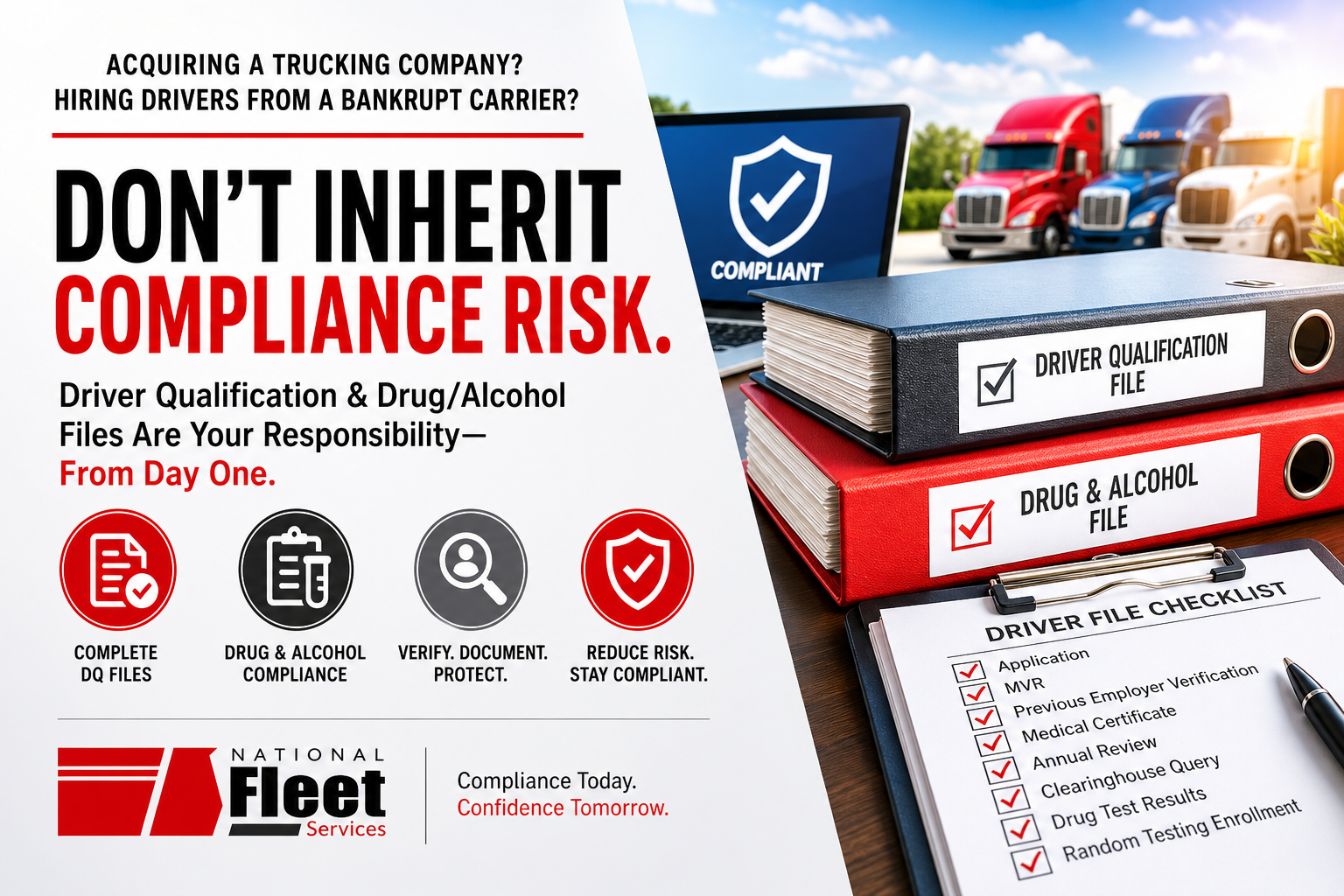
Why This Matters
In an acquisition or when onboarding drivers from a bankrupt carrier, you are effectively inheriting:
- Regulatory exposure
- Safety performance history
- Potential audit liabilities
FMCSA does not grant a grace period for incomplete or missing records. If a driver operates under your USDOT number, you are fully responsible for compliance immediately.
1. Driver Qualification (DQ) Files
What a Complete DQ File Must Include
Per 49 CFR Part 391, each driver must have a compliant DQ file containing:
- Driver’s application for employment
- Motor Vehicle Record (MVR) from each state (initial + annual)
- Inquiry to previous employers (last 3 years for safety performance)
- Road test certificate or equivalent CDL documentation
- Medical Examiner’s Certificate (DOT physical)
- Annual driver certification of violations
- Annual MVR review with safety determination
- Entry-Level Driver Training (ELDT) records (if applicable)
Acquisition Scenario: Key Risks
When acquiring a trucking company:
1. Missing or Incomplete Files
It’s common to find:
- Outdated medical cards
- Missing prior employer verifications
- No documented annual reviews
Risk: Immediate FMCSA violations tied to your DOT number post-close.
2. Assumption of Compliance
Buyers often assume:
“If the company was operating, the files must be fine.”
That assumption is frequently wrong—especially with distressed or poorly managed carriers.
3. Liability Transfer
Even if violations occurred pre-acquisition:
- Auditors evaluate current compliance at time of review
- You must fix deficiencies before drivers operate under your authority
Best Practices for DQ Files in M&A
Pre-Close Due Diligence
- Sample and audit a percentage of DQ files
- Identify systemic gaps (not just isolated issues)
- Flag high-risk drivers (missing MVRs, expired medicals)
Day 1 Readiness Strategy
Before drivers operate under your DOT:
- Re-verify CDL and MVR
- Confirm valid medical certificate
- Complete missing employment verifications
Post-Close Remediation
- Rebuild incomplete DQ files
- Document corrective actions
- Implement standardized onboarding processes
2. Drug & Alcohol (D&A) Testing Files
Required Components
Under 49 CFR Part 382, employers must maintain:
- Pre-employment drug test results
- Drug & Alcohol Clearinghouse query results
- Random testing program enrollment
- Post-accident, reasonable suspicion, and return-to-duty records
- Chain of custody forms
- Supervisor training documentation
Acquisition Scenario: Critical Issues
1. Clearinghouse Compliance Gaps
Common findings:
- No pre-employment queries
- No annual queries
- Unresolved violations
Risk: You may unknowingly place a prohibited driver on the road.
2. Random Testing Program Failures
Bankrupt or struggling carriers often:
- Fall out of consortiums
- Miss random testing requirements
Risk: Entire driver pool may be non-compliant.
3. Positive Test / SAP Follow-Up Gaps
Drivers with prior violations may:
- Not have completed Return-to-Duty (RTD) process
- Be missing follow-up testing plans
Risk: Immediate out-of-service violation.
Hiring Drivers from a Bankrupt Carrier
This scenario is especially high-risk because:
- Records may be incomplete or inaccessible
- Third-party administrators (TPAs) may no longer respond
- Drivers may not disclose violations
Required Steps Before Hiring
1. Drug & Alcohol Clearinghouse Queries
You MUST:
- Run a pre-employment query
- Obtain driver consent
- Confirm no unresolved violations
2. Previous Employer Inquiry (D&A History)
For the past 3 years, you must:
- Request drug & alcohol testing history
- Document attempts—even if employer is out of business
3. Pre-Employment Drug Test
Even if the driver was recently tested:
- A new employer must ensure a compliant pre-employment test
- Exception only applies under strict transfer conditions (rare in bankruptcy)
4. Verify Random Testing Enrollment
Driver must be:
- Enrolled in your random testing program before performing safety-sensitive functions
3. Integration Challenges in Transactions
Data Fragmentation
- Paper vs digital records
- Multiple TPAs or consortiums
- Inconsistent formats
Timing Pressure
Deals often close quickly, but:
- Compliance cannot lag operations
- Drivers cannot legally operate while files are incomplete
Cultural Differences
Acquired companies may have:
- Less rigorous compliance standards
- Informal processes
4. Strategic Recommendations
Build a “Compliance Gate” Before Deployment
No driver should operate until:
- DQ file meets minimum regulatory standards
- D&A file is verified and complete
- Clearinghouse status is confirmed
Use a Risk-Based Review Approach
Prioritize:
- Drivers with incomplete records
- Drivers from bankrupt carriers
- Drivers with prior violations or high turnover history
Standardize and Centralize Records
- Implement a uniform DQ/D&A checklist
- Digitize all records
- Align with a single TPA or compliance system
Document Everything
In audits, documentation is your defense:
- Record all attempts to obtain missing records
- Maintain written explanations for gaps
- Show corrective actions taken
5. The Bottom Line
In acquisitions or bankruptcy hiring, DQ and Drug & Alcohol files are not administrative paperwork—they are regulatory landmines.
Failing to properly vet and reconstruct these files can lead to:
- FMCSA penalties
- Out-of-service orders
- Increased CSA scores
- Litigation exposure
Handled correctly, however, they can become a competitive advantage—ensuring:
- Safer operations
- Lower audit risk
- Stronger integration outcomes
fleet insights